
Pine Script® → Python Converter
in Seconds
Your Pine Script code, running in Python
This is not another AI / LLM based Pine Script converter.
Instead, it's a deterministic,
reliable compiler!
1,000/1,000 real TradingView scripts compile & run. See the proof
The Python You Get Back
This is what PyneComp writes for a small Pine indicator. The notes show where each part of your script ends up.
"""
@pyne edge

This code was compiled by PyneComp v6.1.3 — the Pine Script to Python compiler.
Run with open-source PyneCore: https://pynecore.org
Compile Pine Scripts online at PyneSys: https://pynesys.io
"""
# Trend band: an EMA with an ATR envelope around it.

from pynecore.lib import bgcolor, close, color, input, na, plot, script, ta
from pynecore.types import PersistentSeries


@script.indicator("Trend band", overlay=True)
def main(
    # Inputs
    len=input.int(20, "Length"),  # EMA and ATR length
    mult=input.float(2.0, "Multiplier")  # band width in ATRs
):
    def band(center: float, width: float):
        """
        The band around a center line.

        :param center: The center line
        :param width: The distance of each edge from the center
        :return: The upper and the lower edge
        """
        return (center + width, center - width)

    basis = ta.ema(close, len)
    upper, lower = band(basis, ta.atr(len) * mult)

    # A close above the upper edge starts an uptrend,
    # a close below the lower edge ends it.
    up: PersistentSeries[bool] = False
    if close > upper:
        up = True
    elif close < lower:
        up = False

    # The trend turns on the bar where up differs from the bar before.
    turn = up != up[1]

    plot(basis, 'Basis', color.green if up else color.red)
    plot(upper, 'Upper', color.gray)
    plot(lower, 'Lower', color.gray)
    bgcolor(color.new(color.yellow, 80) if turn else na)


if __name__ == "__main__":
    from pynecore.standalone import run
run(__file__)- Lines 1–7
Every file starts with a
@pynedocstring. It marks the file as Pyne code, so PyneCore runs it the way TradingView runs your script, bar by bar. - Line 8
// Trend band: an EMA with an ATR…The comments at the top of your script come right after it. - Lines 15–19
len = input.int(20, "Length") // EMA and ATR lengthInputs become the parameters ofmain. A comment at the end of a line stays at the end of that line. - Lines 20–28
//@function The band around a center line.//@function,//@paramand//@returnsbecome a docstring, which your editor shows when you hover over a call. - Lines 30–31
[upper, lower] = band(basis, …)Your names stay as you wrote them. - Lines 35 and 42
var bool up = false … up[1]varkeepsupfrom bar to bar, andup[1]reads it one bar back. The compiler sees both and makesupaPersistentSeries. Variables you never look back on, likebasis, stay plain Python values. - Lines 48–49 Two blank lines around a top-level function, at most one inside it: the spacing follows PEP 8, the Python style guide.
Tested on 44,000+ Real Scripts
Scripts of every Pine version, nearly 3,000 of them broken. A script TradingView accepts must never be refused.
Pine v1 to v6
Old scripts compile directly and convert to v6. The lines that need no change come back exactly as you wrote them.
Errors Where You Made Them
It rejects what TradingView rejects, and the error points at the line in your Pine script.
Same Script, Same Code
No LLM guessing. The compiler needs less than a millisecond for a typical v6 script.
How It Works
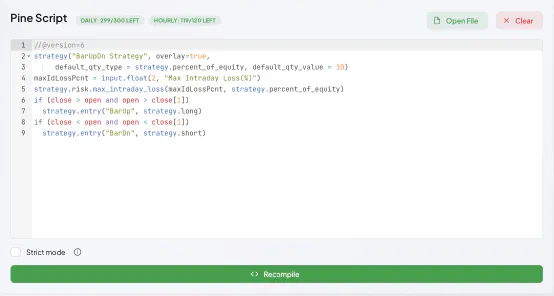
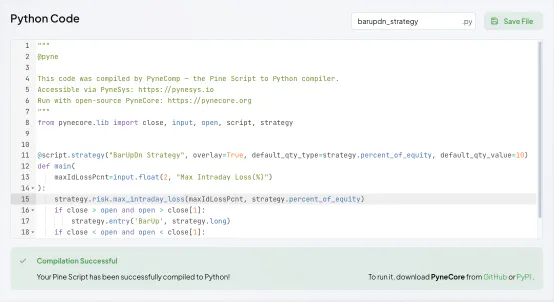
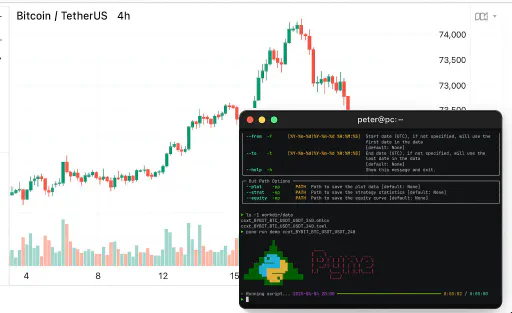
Proof, Not Promises
Don't take our word for it. Pyne in the Wild takes the most popular open-source Pine Script indicators and strategies published on TradingView, compiles each one to Python, and runs it with PyneCore. Wherever TradingView's output can be exported, every plotted value and every trade is compared against it — bar by bar, bit by bit.
The remaining 0.229% of bars? Within 1e-9 relative tolerance — last-digit floating-point rounding, documented per script, because “close enough” deserves a number too. Every result is reproducible: the corpus pins the exact source of each script with a SHA-256 hash.
Browse the Full ReportScript-by-script results at wild.pynesys.io · snapshot 2026-10-24 · the corpus keeps growing
502 indicators, 498 strategies
1,000/1,000, zero failures
bit-exact vs TradingView
across 353,577 compared trades
Try It For Free
Not ready to subscribe yet?
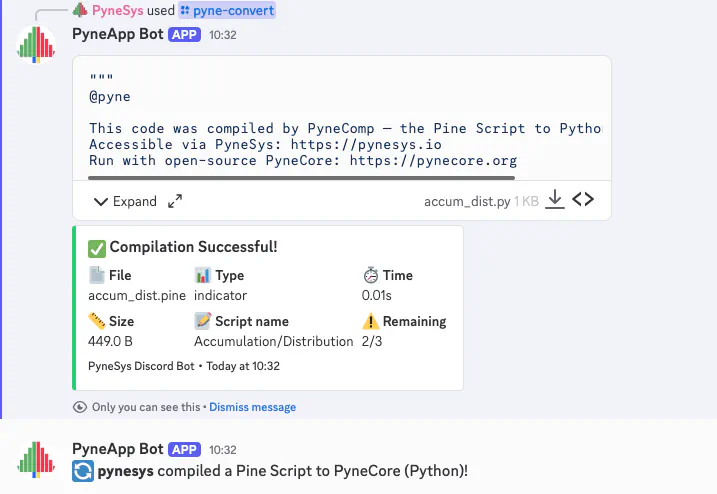
Convert up to 3 scripts for free with our Discord bot.
Go to #pine-compiler-bot channel in PyneSys Discord Server and use the /pyne-help command.
Discord bot conversions support Pine Script v4, v5, and v6 files up to 25KB.
Join Our Discord3 free conversions
CLI & API Integration
The PyneCore CLI is the primary interface today — run your Pine Scripts locally with a single command. For backend automation, the same compiler is exposed as an HTTP API. Pick whichever fits your workflow; both call the same deterministic compiler.
PyneCore CLI
# One-shot: compile via the API, then run locally on your OHLCV data
pyne run my_strategy.pine BTCUSDT_1D.ohlcv

# Or compile only — produces a .py file you can edit and commit
pyne compile my_strategy.pine
The CLI re-compiles only when the .pine file is newer than its generated
.py, so unchanged scripts never hit the API. Set your key once via
PYNESYS_API_KEY, the --api-key flag, or
workdir/config/api.toml.
HTTP API
# POST a Pine Script — get readable PyneCore Python back as plain text
curl -X POST https://api.pynesys.io/compiler/compile \
  -H "Authorization: Bearer $PYNESYS_API_KEY" \
  -F "script=@my_strategy.pine"
POST /compiler/compile returns the compiled Python directly. Identical scripts are
served from the server-side cache instantly and do not consume your compile quota. Full
interactive reference at
api.pynesys.io/docs.
Key Features
- Personal Bearer API keys — create, rotate, or revoke any time from your dashboard
- Smart server-side cache — re-compiling the same Pine Script returns instantly and does not bill your quota
- Mtime-aware CLI — skips the API entirely when your
.pinesource hasn't changed - Output is human-readable PyneCore Python — read it, edit it, version-control it
- Interactive OpenAPI reference at
api.pynesys.io/docs
Compiler Pricing
The same subscription covers Pine Script compilation in PyneIDE, from the CLI and through the API.
Try the compiler with 3 free script conversions through our Discord bot. Join the server and open the #pine-compiler-bot channel to get started.
Try on DiscordSeed
For bringing one or two Pine indicators over to Pyne. Convert them here and keep working on the Pyne code in PyneIDE, where running and debugging it is free.
- 5 script conversions per day
- 1 script conversion per hour
- Every 3 failed conversions count as 1 toward your limits
- 1 API key
Sprout
For converting Pine scripts regularly. Each conversion gives you Pyne code that you can edit, run and debug in PyneIDE for free.
- 30 script conversions per day
- 5 script conversions per hour
- Every 3 failed conversions count as 1 toward your limits
- 2 API keys
Grower
For writing Pine Script every day in PyneIDE. The IDE recompiles your script each time you run it after an edit, so this plan allows 60 compiles an hour.
- 700 script conversions per week
- 60 script conversions per hour
- Every 3 failed conversions count as 1 toward your limits
- 5 API keys
Forest
For staying with Pine Script and using PyneIDE all day. Your scripts stay in Pine, so you get the IDE's debugger and live chart and can keep working on TradingView too.
- 2,100 script conversions per week
- 120 script conversions per hour
- Every 3 failed conversions count as 1 toward your limits
- 10 API keys
Plan Comparison
| Seed | Sprout | Grower | Forest | |
|---|---|---|---|---|
| Price | $8 | $18 | $28 | $48 |
| Pine compiles | 5 per day | 30 per day | 700 per week | 2100 per week |
| Pine compiles per hour | 1 | 5 | 60 | 120 |
| API Keys | 1 | 2 | 5 | 10 |
| Max Script Size | 25 KB | 50 KB | 150 KB | 300 KB |
- Each run of a changed
.pinefile is one compile. Unchanged scripts come from the cache and don't count. - Converting a Pine v4 or v5 script to v6 doesn't use your quota.
- The generated Pyne code is yours to read, edit and keep.
Most scripts convert 1:1 and run as-is. When one doesn't, the generated Python is readable, so a small manual edit usually gets it working. See the FAQ and the PyneCore Compatibility page for details.
Join Our Community
Connect with other traders, developers, and the PyneSys team.


Frequently Asked Questions
No. Keep charting and publishing on TradingView, and develop your scripts in PyneIDE. There they are files in your own git repository, and you can step through them bar by bar in a debugger, which TradingView doesn't have.
It automatically transforms your Pine Script code into Python-compatible "Pyne" code. This Pyne code can be run in an open-source system called PyneCore, which preserves Pine semantics but in Python form.
Classic compiler! We don't use any LLM/GPT-based generation, only deterministic transformation rules (full lexical parser → AST → transform → codegen pipeline). This ensures reliable, predictable conversion results every time.
For PyneIDE, only VS Code and the extension. PyneIDE downloads its own Python and the PyneCore runtime the first time you need them, so you don't need a system Python.
Without the IDE, you can use the compiler through the web app, the PyneCore CLI or the HTTP API. The CLI calls the API and only converts a script that isn't in the cache yet.
With the PyneCore system, it can run on any platform: Linux, macOS, Windows. The system requires Python 3.11+ and doesn't use cumbersome external dependencies.
Pine Script is TradingView's programming language. We're not copying or reverse-engineering it, but building an independent system that is functionally compatible with it. This means the same logic and behavior applies, but in Python language, with full control and customizability.
No. The compiler only converts Pine Script to Pyne code, and conversion in the other direction isn't planned for the near future.
You don't need it to backtest locally and keep the script running on TradingView. Keep the Pine Script file as your source and run it with PyneCore or PyneIDE, which compile it through the PyneSys compiler API in the background (this needs an API key from one of the plans). When you're happy with the results, publish the same file on TradingView. You only work with the Python side if you want to.
Almost always. Of the 1,000 published TradingView scripts in Pyne in the Wild, 1,000 convert as they are, and 1,353 of the 1,353 outputs that can be compared with TradingView match it: plots bar by bar, strategies trade by trade.
If a script still misbehaves, the generated Python is human-readable, and the Compatibility page shows the status of every Pine Script feature in PyneCore.
Found a bug or a missing feature? Please flag it on Discord or GitHub — that's the fastest way to get it fixed.
PyneComp compiles scripts written in Pine Script v1 through v6 to Pyne code. It can also upgrade older scripts to Pine Script v6.